
Promoting Post-16 Opportunities In Leeds
What is the Leeds post-16 Directory?
YLP have launched the Leeds 16-18 provision directory, which brings together the offer for young people across the city, specifically focusing on study programme providers.
We have referenced all post-16 options and signposted the apprenticeship offer to our Yorkshire Apprenticeship service platform but wanted to develop a dedicated resource just for study programmes across the City.
This resource includes access to the online search function and has been shared far and wide, including with local authorities, WY police, Youth Justice, Young lives Leeds, voluntary action Leeds, NHS trusts and partners.
We hope this directory and search function will bring more awareness to the offer and the providers who can support young people across the city. Find out what else we’re doing to help the NEET crises in our response to the NEET crises case study.
Sam Low, Positive Destination Manager at Leeds City Council said, “The Post 16 directory is a welcome and much needed addition to the online, information and guidance space. The platform will not only support young people to identify their progression options, but it will also provide an important opportunity for professionals and careers practitioners to better understand the variety of EET offer available from Independent Training providers. The directory is a great way for young people to make informed choices, offering several different pathway options to explore.”
FAQ's for Study Programmes
Study programmes are provided to 16-19 year olds so they can undertake a range of experiences including, education, work experience, employability, vocational and personal development that will help them gain a job or prepare for further study. They are tailored programmes, depending on prior qualifications, life or career goals and background.
Study programmes are flexible programmes built around the needs of individual students. They must be aged 16-19 years old, not on any other education or employment programmes and be available to complete at least a 1 year programme. That may lead to 2 years depending on the progression and destination of choice.
These programmes are delivered at a college or providers centre or campus. They are either full time or part time, depending on need, or circumstance of the learner. All study programmes include employability, English, maths and some form of real world experience of the workplace. There may be digital skills development, vocational pathways into work, such as construction or health care, and there will be a strong focus on personal development, well-being and social development. Learners will work in small groups, and will be classroom and online learning opportunities.
FAQ's for Alternative Provisions
Specialist & alternative provision for 16-18 year olds includes various educational and support services tailored to meet the diverse needs of young people.
It’s important to remember that learning can happen anytime and anywhere and that education and learning can happen now or later when the child/young person is ready to engage.
Learning can be lifelong and not just involve GCSEs & A-Levels
To retain information, to engage, to actively learn, the body and brain needs to be in a relaxed and calm state.
If a child or young person is distressed, having mental health difficulties, is unwell or recovering from an operation, grieving or being bullied etc it’s very likely they will struggle with their learning/education until they are regulated, calm and their basic needs have been met.
ALTERNATIVE OPTIONS IF SCHOOL ATTENDANCE IS PROBLEMATIC INCLUDE:
- Applying for an EHCP/EOTAS
- Elective Home Education
- Exploring options offered at local colleges for 14-16 year olds (if appropriate)
- Requesting alternative provision under Section 19 of the Education Act 1996
- Moving to a different school in your local area (arranging it yourself or through a Managed Move)
- A Private/Independent School setting/provision
- Flexischooling
- Online school (self-funded or as Alternative Provision)
- Online Learning
- Self-directed Learning
- Vocational and Recreational Courses
- Community and Life Skills Awards (i.e. ASDAN, Duke of Edinburgh, Princes Trust, Springpod)
- Alternative academic qualifications (i.e. T-levels, BTECS, Functional Skills, Open University)
- Volunteering
Reference – Not Fine in School – Education, Alternatives
Q&A for Apprenticeships
An apprenticeship for 16–18-year-olds is a paid job where you learn practical skills while working, and at the same time study toward a recognised qualification. It’s an alternative to staying in full-time school or college after age 16.
Numerous companies in Leeds offer apprenticeships, including large national employers like HSBC, Amazon, Leeds United, ASDA & The NHS, as well as local organizations such as Leeds City Council. Companies from various sectors, including IT, engineering, healthcare, and retail, provide opportunities through training providers.
A 16–18 apprenticeship is open to anyone aged 16 to 18 who has finished Year 11, is no longer in full-time education, and has the right to work in the UK. Young people in this age group can start an apprenticeship as long as they are able to take on a real job with training, and although some roles may ask for GCSE English or Maths, many allow you to study these qualifications during the programme.
A 16–18 apprenticeship is delivered through a mix of on-the-job training and off-the-job learning. Apprentices spend most of their time working in a real job, gaining hands-on experience with support from a mentor. Alongside this, they complete structured learning with a training provider or college, which may take place in a classroom, online, or through workshops. At least 20% of their time must be spent on this off-the-job training. Throughout the programme, apprentices work toward a recognised qualification and are assessed through assignments, practical tasks, and an end-point assessment.
Q&A for T-Levels
T-levels are academic programmes, that last for 2 years and are equivalent to 3 A levels, but have a work placement element attached to them.
These courses have been developed in collaboration with employers and education providers so that the content meets the needs of industry and prepares students for entry into skilled employment, an apprenticeship or related technical study through further or higher education
The courses are available at selected colleges, schools and other providers across the City, and are open to those aged 16-19 years old who have a minimum of 5 GCSE’s including English & maths – typically at grade 4 and above
T Levels offer students practical and knowledge-based learning at a school or college and on-the-job experience through an industry placement of at least 315 hours – approximately 45 days.
Q&A for Supported Internships
The courses are available at selected colleges, schools and other providers across the City, and are open to those aged 16-19 years old who have a minimum of 5 GCSE’s including English & maths – typically at grade 4 and above.
These are mainly public sector, large corporate organisations who have excellent support and pastoral arrangements in place for the young people.
This includes councils, NHS, Government departments.
16- to 24-year-olds with SEND, who have an education, health and care (EHC) plan
Every young person is supported in the work placement by a job coach, put in place by their education provider.
There are no entry or completion requirements for supported internships, and each learning provider will work with their supported interns to develop a personalised programme that meets their needs and provides progression and stretch.
Supported internships are a structured, work-based study programme for 16- to 24-year-olds with SEND. Supported interns are enrolled in full-time education and their work placements are part of their course. Typically they spend around 70 per cent of their time in the wo
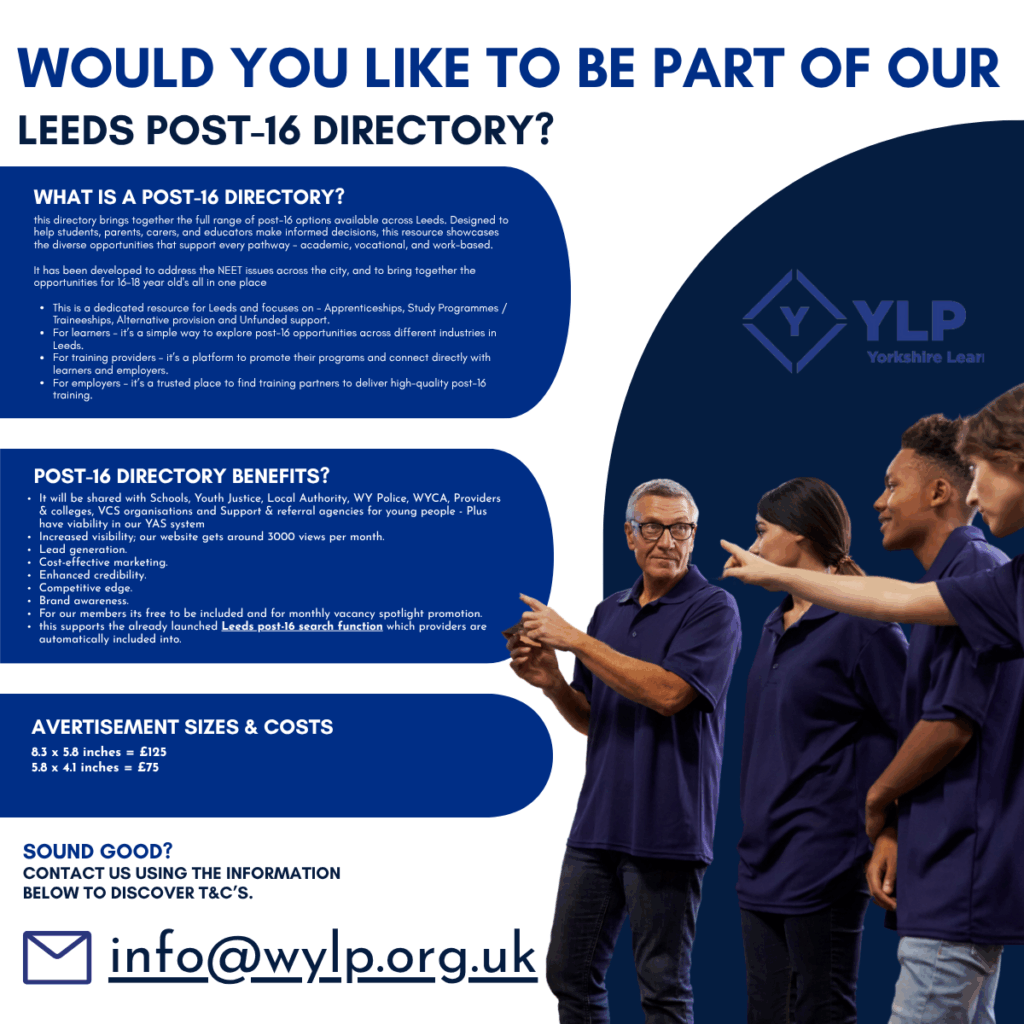
What are some key benefits to advertising in our Post-16 Directory?
- Increased visibility & reach to prospective students and stakeholders.
- Credibility and trust by association.
- Access to broader networks, collaborations & referrals.
- Helping match the right learners to the right provision.
- Strategic marketing & recruitment.